MLELE – Advanced Intelligent WiFi Circuit Breaker Enterprise: Integration with Smart City Infrastructure
WENZHOU, ZHEJIANG, CHINA, November 17, 2026 /EINPresswire.com/ -- Modern municipal infrastructure relies on distributed
Press Release Disclaimer: This is a press release distributed through the XPR Media network. It has not been independently verified by our newsroom.
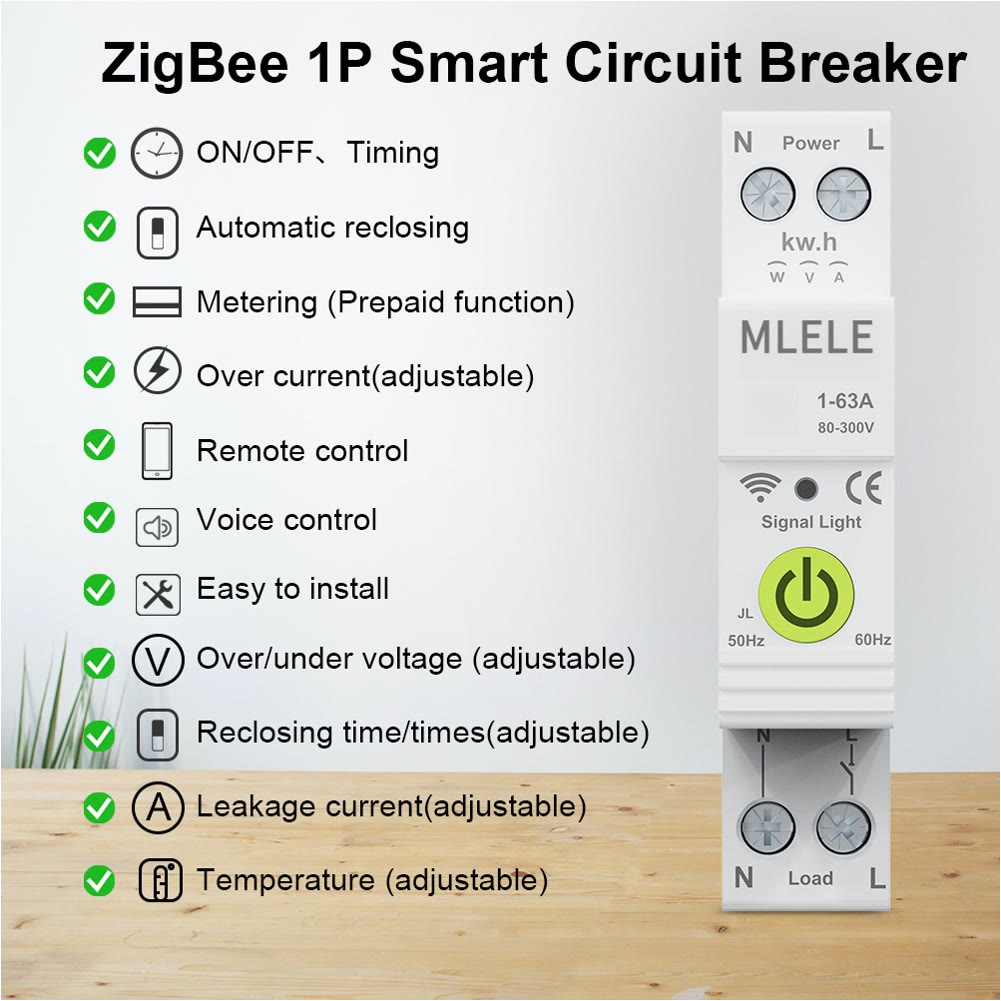

WENZHOU, ZHEJIANG, CHINA, November 17, 2026 /EINPresswire.com/ — Modern municipal infrastructure relies on distributed low-voltage distribution pillars to support public lighting networks and remote utility assets. Operating these dispersed outdoor electrical assets requires supervisory systems capable of 24/7 parameter telemetry, noise-tolerant wireless communication across shielded metal enclosures, and automated service restoration following atmospheric disturbances. Traditional outdoor feeder cabinets depend on manual maintenance dispatches to inspect tripped circuits, extending public service interruptions after seasonal rainstorms. Modern municipal standards prioritize migrating toward decentralized energy internet-of-things (IoT) sensing nodes that combine high-speed True-RMS energy measurement with motorized actuation and automated line health checks. Operating from its specialized manufacturing base established in 2010 in Liushi, Wenzhou, Zhejiang Mulang Electrical Technology Co., Ltd. (known globally as MLELE) engineers low-voltage apparatus within disciplined quality management frameworks. By directing manufacturing capacity and electronics integration toward intelligent WiFi circuit breakers, the enterprise provides municipal engineering contractors and urban utilities with standardized DIN-rail switching units engineered to modernize municipal power infrastructure.
Deploying intelligent circuit breakers across extensive municipal grids transforms localized distribution cabinets into active edge-computing nodes. Within outdoor feeder pillars, each modular breaker incorporates dual-transceiver wireless communication hardware supporting local 2.4 GHz WiFi networks alongside wide-area 4G LTE cellular protocols. In challenging outdoor radio frequency environments where metallic enclosures and dense urban structures attenuate wireless signals, the device firmware implements automated reconnection handshakes and local data-queuing buffers, preserving operational event logs during temporary cellular carrier drops. Central municipal management platforms poll these decentralized endpoints via authenticated application interfaces, collecting concurrent telemetry comprising phase voltages, load currents, active power draws, and power factor curves. This continuous data aggregation feeds municipal digital-twin models, allowing operational supervisors to map district-level consumption trends, identify abnormal branch loading before insulation degradation develops, and issue synchronized group switching commands across designated public infrastructure zones.
Intelligent Streetlighting Automation and Astronomical Time Scheduling
Managing municipal illumination networks requires balancing public nighttime illumination with municipal energy conservation mandates. The intelligent circuit breaker integrates an onboard microcomputer clock and programmable logic that execute astronomical timing algorithms based on local latitude and longitude coordinates. Instead of relying on external light sensors susceptible to dust accumulation, the internal controller automatically recalculates daily sunrise and sunset curves, shifting branch lighting circuits precisely at dusk and dawn. For secondary road networks and architectural floodlighting, the firmware supports multi-tiered night schedules that de-energize alternate lighting circuits during low-traffic early morning hours to curb electrical consumption. In parallel with automated switching, high-speed metering chips continuously record branch voltage, active wattage, and cumulative energy consumption (kWh), supplying municipal utility departments with verifiable audit records to verify streetlighting operational efficiency.
The astronomical algorithm automatically compensates for leap years and seasonal solstices, avoiding the gradual timing drift common in conventional analog mechanical timers. Municipal maintenance teams can define specialized operational profiles for public holiday illumination or emergency weather conditions, pushing updated switching schedules over the wireless network to thousands of distributed cabinets simultaneously.
Adaptive Residual Current Monitoring and Automated Service Restoration
Maintaining continuous municipal service during severe storm events requires discrimination between transient electrical disturbances and permanent physical line faults. High-energy atmospheric lightning events and severe rainstorms frequently induce temporary voltage swells and transient residual current spikes along outdoor lighting poles and submersible pumping circuits, prompting protective breakers to trip. Following a tripping event, the intelligent breaker initiates an automated evaluation routine instead of remaining passively open. The internal microcomputer activates a monitoring delay window, verifying whether residual current levels have dissipated within safe operational thresholds. If the diagnostic cycle confirms that transient fault currents have cleared and line parameters have normalized, the motorized drive mechanism executes a calibrated automatic reclosing sequence, restoring power to streetlights and municipal drainage pumps without requiring manual field maintenance visits.
If a permanent physical fault exists, such as a submerged cable joint or grounded luminaire conductor, the intelligent controller halts reclosing attempts after a pre-set number of verification cycles. The unit then locks in the isolated open state and generates an immediate geographic alarm with exact electrical fault coordinates, enabling maintenance crews to dispatch directly to the affected cabinet location.
Outdoor Thermal Resilience and Coordinated Surge Suppression
Operating inside unconditioned outdoor street cabinets exposes electrical apparatus to severe ambient temperature fluctuations and electrical transients. MLELE modular intelligent breakers are engineered to deliver steady mechanical articulation and calibrated tripping thresholds across an ambient operating temperature boundary from -5 deg C to +40 deg C, with permissible 24-hour daily averages reaching +35 deg C. The molded thermoset housing maintains high mechanical rigidity, flame retardancy, and tracking resistance under elevated humidity. To safeguard onboard microprocessors against inductive lightning surges, the breaker operates in coordination with MLELE’s MLY1-series surge protective devices (SPD) installed at the cabinet service entrance. The SPD shunts high-energy transient surges safely to earth ground, clamping incoming voltage spikes down to safe protection levels ($U_p le 1.8 ext{kV}$), preventing electrical transients from propagating into downstream intelligent breaker controls and municipal communication transceivers.
Differentiated Municipal Packaging and Certified Compliance
Supplying distributed municipal infrastructure projects involves packaging standardized DIN-rail switching apparatus for outdoor feeder cabinets. Operating within the electrical industrial base of Liushi, MLELE verifies that intelligent breakers maintain steady contact retention and dielectric insulation across -5 deg C to +40 deg C operating conditions under a certified ISO 9001 quality framework. Evaluation samples for municipal pilot trials are dispatched within approximately 7 days, with commercial volume infrastructure rollouts delivered within 20 to 30 days. Shipments are backed by complete CCC type-test documentation, CE declarations, and factory inspection logs, supported by MLELE’s broader catalog of low-voltage distribution apparatus.
Integrating intelligent WiFi circuit breakers across urban utility networks reinforces power distribution reliability and advances digital municipal management. Smart city EPC planners, municipal electrical consultants, and urban infrastructure developers can review detailed technical specifications, obtain CAD enclosure drawings, and request factory evaluation units by visiting the official international portal:
Zhejiang Mulang Electrical Technology Co., Ltd.
MLELE
Visit us on social media:
Facebook
Legal Disclaimer:
EIN Presswire provides this news content “as is” without warranty of any kind. We do not accept any responsibility or liability
for the accuracy, content, images, videos, licenses, completeness, legality, or reliability of the information contained in this
article. If you have any complaints or copyright issues related to this article, kindly contact the author above.

Media gallery